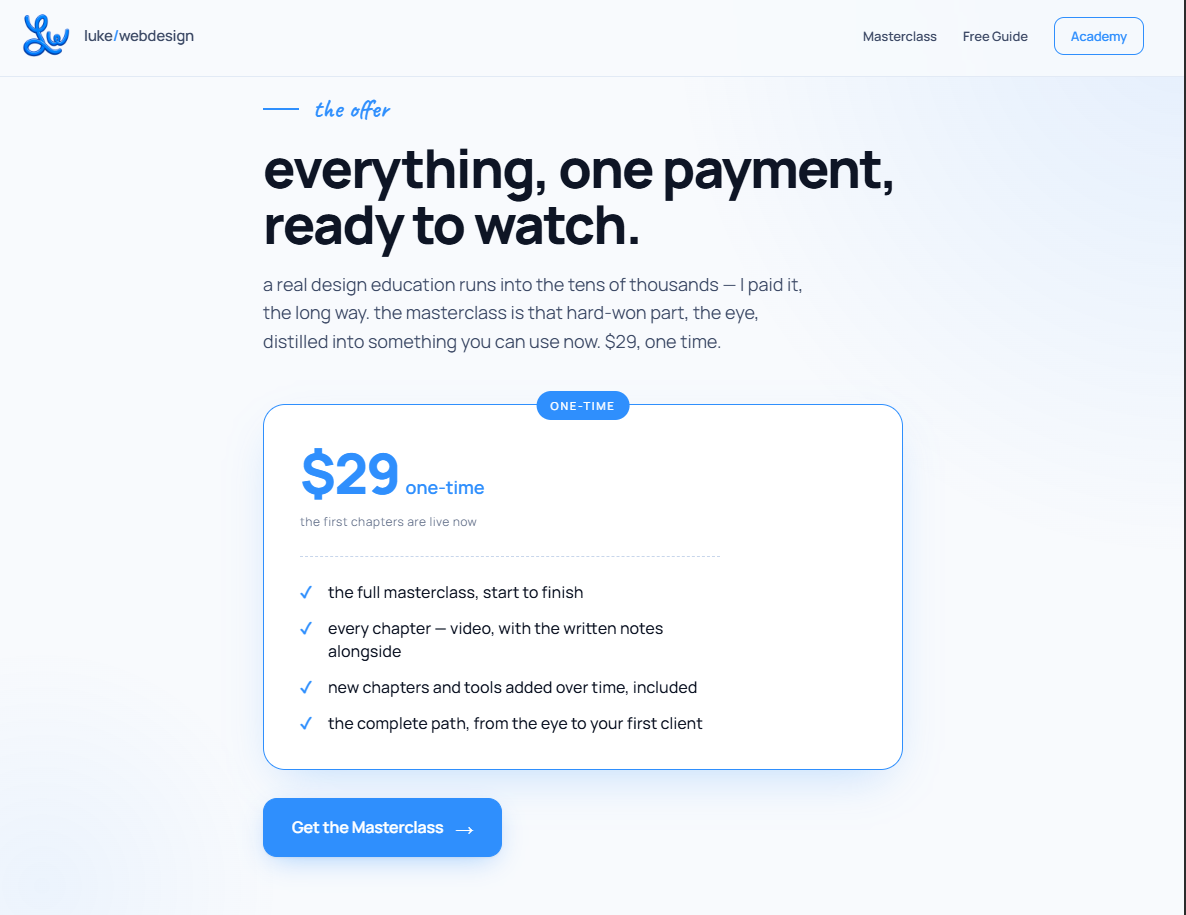
lukewebdesign – AI Web Design Guide
$29.00 Original price was: $29.00.$14.00Current price is: $14.00.
- 24/7 Contact Support & Telegram - Ecomkevin_1
- You Can Request Any Courses
- Original Courses HD Qualite and links updated
Guaranteed Safe Checkout


Description
LukeWebDesign AI Web Design Guide
The digital landscape has evolved dramatically over the last few years, and artificial intelligence has become one of the most powerful tools in modern website creation. Businesses, freelancers, agencies, and entrepreneurs are leveraging AI-driven technologies to streamline workflows, improve user experiences, and build high-performing websites faster than ever before.
This comprehensive guide explores the methodologies, strategies, and practical applications behind modern AI-powered web design. Whether you’re a beginner building your first website or an experienced designer seeking advanced optimization techniques, this guide provides actionable insights that can transform the way websites are planned, designed, and launched.
Understanding AI in Modern Web Design
Artificial Intelligence is no longer a futuristic concept. It is actively reshaping how websites are developed, optimized, and maintained.
AI assists designers by:
- Automating repetitive design tasks
- Generating website layouts
- Creating engaging content
- Optimizing user experiences
- Enhancing search engine visibility
- Improving conversion rates
- Personalizing visitor journeys
Traditional website development often requires extensive planning, coding, content creation, and testing. AI significantly reduces the time required while maintaining high-quality results.
The biggest advantage lies in efficiency. Designers can focus more on strategy and creativity while automation handles technical processes.
Why AI is Revolutionizing Website Creation
Businesses today face intense online competition. A website is no longer just a digital brochure—it serves as a sales machine, lead generation platform, and brand authority hub.
AI helps solve common challenges such as:
Faster Development Cycles
Instead of spending weeks creating wireframes and prototypes, AI tools can generate professional layouts within minutes.
Improved User Experience
Machine learning algorithms analyze user behavior and suggest improvements that increase engagement and reduce bounce rates.
Better Conversion Optimization
AI identifies patterns that influence purchasing decisions, helping businesses maximize revenue from existing traffic.
Data-Driven Design Decisions
Rather than relying on guesswork, AI provides actionable insights based on real visitor interactions.
Core Principles of AI-Powered Web Design
Successful websites still rely on fundamental design principles. AI enhances these principles rather than replacing them.
User-Centered Design
Every design decision should prioritize the visitor experience.
Questions to consider:
- What problem does the website solve?
- How quickly can users find information?
- Is navigation intuitive?
- Are call-to-action buttons clearly visible?
AI tools can analyze user interactions and reveal friction points that may otherwise go unnoticed.
Visual Hierarchy
Effective websites guide users through content naturally.
Important elements include:
- Headlines
- Images
- Buttons
- Forms
- Product showcases
Artificial intelligence can help determine optimal placement for these elements based on behavioral analytics.
Mobile-First Development
Mobile traffic now dominates internet usage globally.
Modern AI systems automatically generate responsive layouts optimized for:
- Smartphones
- Tablets
- Laptops
- Desktop computers
This ensures consistent performance across all devices.
AI-Assisted Website Planning
Before designing a website, proper planning is essential.
AI-powered planning tools can help identify:
Target Audience
Understanding visitors allows businesses to create highly relevant experiences.
AI can analyze:
- Demographics
- Interests
- Purchasing behavior
- Search intent
- Online activity patterns
Competitor Analysis
Competitive research traditionally takes hours.
AI can instantly evaluate:
- Competitor websites
- Design trends
- Keyword strategies
- Content structure
- User engagement factors
This information helps create a stronger market position.
Content Mapping
A well-organized website structure improves both usability and SEO.
Recommended pages often include:
- Home
- About
- Services
- Products
- Blog
- Contact
- Testimonials
- FAQ
AI can suggest optimal site architecture based on industry best practices.
Building Professional Website Layouts with AI
Layout creation is one of the most time-consuming aspects of web design.
AI simplifies the process through intelligent design generation.
Homepage Design
A strong homepage should include:
Hero Section
The hero section creates the first impression.
Essential elements:
- Clear headline
- Supporting text
- Strong CTA
- Relevant visuals
Trust Signals
Build credibility using:
- Testimonials
- Reviews
- Certifications
- Awards
- Client logos
Benefits Section
Explain why visitors should choose your business.
Focus on outcomes rather than features.
Service Pages
High-converting service pages should contain:
- Service overview
- Benefits
- Process explanation
- Case studies
- FAQs
- Contact forms
AI tools can automatically structure these sections for maximum readability.
Landing Pages
Landing pages are designed for a single objective.
Best practices include:
- One clear offer
- Minimal distractions
- Strong CTA
- Persuasive copy
- Social proof
AI-driven heatmaps can reveal which sections generate the highest engagement.
AI Content Creation for Websites
Content remains one of the most important ranking and conversion factors.
AI can assist with:
Website Copywriting
Generate:
- Headlines
- Service descriptions
- Product content
- Call-to-actions
- FAQs
However, human editing remains essential to maintain authenticity and brand voice.
Blog Content
Regular blogging improves:
- Organic traffic
- Search visibility
- Industry authority
- Lead generation
AI accelerates content production while maintaining quality standards.
Content Personalization
Visitors expect personalized experiences.
AI can dynamically adjust:
- Headlines
- Product recommendations
- Offers
- Content blocks
This increases engagement and conversion rates.
Search Engine Optimization and AI
SEO is critical for website visibility.
AI-powered SEO tools help improve rankings through:
Keyword Research
Identify:
- High-volume opportunities
- Long-tail keywords
- Search intent
- Ranking difficulty
On-Page Optimization
Improve:
- Meta titles
- Meta descriptions
- Header structure
- Internal linking
- Content relevance
Technical SEO
AI can monitor:
- Page speed
- Mobile responsiveness
- Broken links
- Crawl errors
- Schema implementation
This helps maintain optimal search engine performance.
User Experience Optimization
A beautiful website means little if visitors struggle to use it.
AI enhances user experience through behavioral analysis.
Heatmaps
Heatmaps reveal:
- Click patterns
- Scroll behavior
- User attention areas
Designers can use this information to improve layouts.
Session Recordings
Watching user sessions helps identify:
- Navigation issues
- Form abandonment
- Confusing interfaces
AI categorizes patterns automatically.
Smart Recommendations
AI systems continuously suggest:
- Layout improvements
- Conversion opportunities
- UX enhancements
These insights lead to better overall performance.
Conversion Rate Optimization Using AI
Traffic alone does not generate revenue.
Conversion optimization ensures visitors take action.
Intelligent A/B Testing
AI can automatically test:
- Headlines
- Button colors
- Layout variations
- Pricing displays
- CTA placement
Winning versions are implemented based on performance data.
Predictive Analytics
Predictive models identify:
- Purchase likelihood
- Lead quality
- User intent
- Revenue opportunities
This enables smarter marketing decisions.
Dynamic Personalization
Different users have different needs.
AI customizes experiences based on:
- Location
- Device
- Behavior
- Referral source
- Previous interactions
Branding and Design Consistency
Strong branding builds trust and recognition.
AI supports branding through:
Color Selection
AI can recommend color palettes aligned with:
- Industry standards
- Brand personality
- Audience preferences
Typography Optimization
Choosing proper typography improves readability.
AI helps identify font combinations that enhance user experience.
Visual Consistency
Maintain consistency across:
- Pages
- Graphics
- Icons
- Buttons
- Marketing materials
This creates a professional appearance.
Website Performance and Speed Optimization
Fast websites perform better in search engines and conversions.
AI-powered optimization includes:
Image Compression
Reduce file sizes while maintaining quality.
Code Optimization
Remove unnecessary scripts and improve loading efficiency.
Resource Management
Optimize:
- CSS
- JavaScript
- Fonts
- Media files
This results in faster page speeds and better user experiences.
Future of AI in Web Design
Artificial intelligence will continue evolving rapidly.
Future developments may include:
- Fully automated website creation
- Real-time personalization
- Predictive design systems
- Advanced voice interfaces
- AI-generated interactive experiences
Businesses adopting these innovations early will gain significant competitive advantages.
Best Practices for Long-Term Success
To maximize results:
- Focus on user experience first.
- Use AI as a tool, not a replacement for creativity.
- Prioritize website speed.
- Maintain strong branding.
- Continuously optimize content.
- Monitor analytics regularly.
- Implement SEO best practices.
- Test conversion elements consistently.
- Keep design clean and modern.
- Adapt to emerging technologies.
Conclusion
Artificial intelligence has fundamentally transformed modern website development. By combining strategic planning, intelligent automation, SEO optimization, user experience enhancements, and conversion-focused design principles, businesses can create websites that not only look exceptional but also deliver measurable results.
The most successful websites of today are built through a balance of human creativity and AI-powered efficiency. Organizations that embrace this approach can achieve faster development, better performance, stronger search visibility, and significantly higher conversion rates.
As technology continues advancing, AI-driven web design will become increasingly essential for businesses seeking sustainable online growth and long-term digital success.
Reviews
There are no reviews yet.