
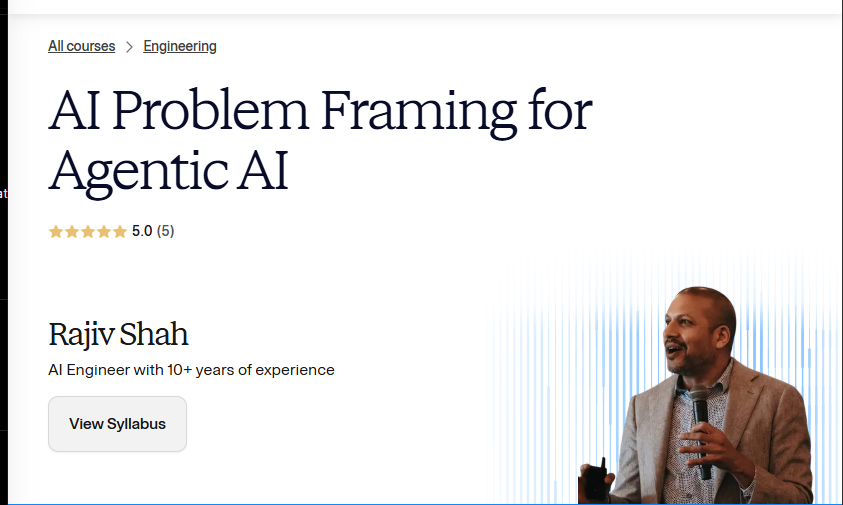
Rajiv Shah – AI Problem Framing for Agentic AI
$980.00 Original price was: $980.00.$40.00Current price is: $40.00.
- 24/7 Contact Support & Telegram - Ecomkevin_1
- You Can Request Any Courses
- Original Courses HD Qualite and links updated
Guaranteed Safe Checkout


Description
Rajiv Shah – AI Problem Framing for Agentic AI
Introduction
In the rapidly evolving world of artificial intelligence, the ability to define the right problem is becoming more valuable than solving it. Rajiv Shah – AI Problem Framing for Agentic AI represents a powerful shift in how developers, entrepreneurs, and AI practitioners approach building intelligent systems. Instead of jumping straight into model selection or automation workflows, this methodology emphasizes understanding the problem space deeply before designing agentic solutions.
Agentic AI—systems that can act autonomously, make decisions, and adapt dynamically—requires precise direction. Without clear problem framing, even the most advanced AI agents fail to deliver meaningful results. This is where structured problem framing becomes essential.
What is AI Problem Framing?
AI problem framing is the process of defining, structuring, and contextualizing a problem before applying artificial intelligence solutions. It involves identifying goals, constraints, stakeholders, data requirements, and expected outcomes.
In the context of Rajiv Shah – AI Problem Framing for Agentic AI, the focus is on enabling AI agents to operate effectively by giving them a well-defined mission. This ensures that agents are not just reactive tools but proactive systems capable of delivering value.
Why Problem Framing Matters in Agentic AI
Agentic AI systems differ from traditional AI models. They are designed to:
- Operate autonomously
- Make decisions in real time
- Interact with environments
- Learn and adapt continuously
Without proper framing, these systems can:
- Misinterpret objectives
- Produce irrelevant outputs
- Waste computational resources
- Create unpredictable behaviors
By applying Rajiv Shah – AI Problem Framing for Agentic AI, developers can ensure clarity, alignment, and efficiency in AI system design.
Core Principles of Effective AI Problem Framing
1. Define the Objective Clearly
The first step is to articulate what success looks like. A vague goal like “improve efficiency” is not enough. Instead, define measurable outcomes such as:
- Reduce response time by 30%
- Increase conversion rate by 15%
Clear objectives guide agent behavior and decision-making.
2. Understand the Context
AI agents operate within environments. Understanding the context includes:
- Industry domain
- User behavior
- Data availability
- External constraints
This ensures the agent acts appropriately in real-world scenarios.
3. Identify Constraints
Constraints help narrow down the solution space. These may include:
- Budget limitations
- Regulatory requirements
- Technical boundaries
- Ethical considerations
In Rajiv Shah – AI Problem Framing for Agentic AI, constraints are not obstacles—they are guiding factors.
4. Break Down the Problem
Complex problems should be divided into smaller, manageable components. This allows:
- Modular AI design
- Easier debugging
- Improved scalability
5. Define Success Metrics
Metrics provide a way to evaluate performance. Common metrics include:
- Accuracy
- Precision and recall
- User satisfaction
- ROI
The Role of Agentic AI
Agentic AI systems are designed to act like intelligent assistants or autonomous operators. They can:
- Plan tasks
- Execute actions
- Analyze feedback
- Optimize outcomes
However, their effectiveness depends entirely on how well the problem is framed. That’s why Rajiv Shah – AI Problem Framing for Agentic AI is critical—it ensures that agents operate with purpose and direction.
Step-by-Step Framework for AI Problem Framing
Step 1: Problem Identification
Start by identifying the core issue. Ask:
- What is the main challenge?
- Who is affected?
- Why does it matter?
Step 2: Stakeholder Analysis
Understand who benefits from the solution:
- Customers
- Businesses
- Developers
- End-users
Step 3: Data Assessment
Evaluate available data:
- Is it structured or unstructured?
- Is it sufficient?
- Is it reliable?
Step 4: Define Agent Capabilities
Determine what the AI agent should be able to do:
- Decision-making
- Automation
- Communication
- Learning
Step 5: Risk Evaluation
Identify potential risks:
- Bias in data
- Security issues
- Ethical concerns
Step 6: Prototype and Iterate
Build a small prototype and test it. Use feedback to refine the problem framing.
Real-World Applications
1. Customer Support Automation
Using Rajiv Shah – AI Problem Framing for Agentic AI, businesses can design agents that:
- Understand customer intent
- Provide accurate responses
- Escalate complex issues
2. Marketing Optimization
AI agents can:
- Analyze user behavior
- Predict trends
- Optimize campaigns
3. Healthcare Decision Support
Proper framing ensures AI agents:
- Assist doctors
- Analyze patient data
- Recommend treatments responsibly
4. E-commerce Personalization
Agents can:
- Recommend products
- Improve user experience
- Increase conversions
Common Mistakes in AI Problem Framing
- Starting with the solution instead of the problem
- Ignoring data limitations
- Overcomplicating the problem
- Lack of clear success metrics
- Not considering ethical implications
Avoiding these mistakes is a key aspect of mastering Rajiv Shah – AI Problem Framing for Agentic AI.
Benefits of Proper AI Problem Framing
- Improved accuracy and performance
- Reduced development time
- Better alignment with business goals
- Enhanced scalability
- Increased ROI
Tools and Techniques
To implement effective problem framing, consider:
- Mind mapping
- Flowcharts
- Data visualization tools
- AI prototyping platforms
- Feedback loops
These tools help structure thinking and improve clarity.
Future of Agentic AI and Problem Framing
As AI continues to evolve, problem framing will become even more important. Future trends include:
- Self-framing AI systems
- Collaborative human-AI problem definition
- Real-time adaptive problem framing
- Ethical AI frameworks
Rajiv Shah – AI Problem Framing for Agentic AI is not just a methodology—it is a foundational skill for the future of AI development.
Conclusion
In the world of agentic AI, success is not determined by the complexity of algorithms but by the clarity of the problem being solved. Rajiv Shah – AI Problem Framing for Agentic AI provides a structured approach to defining problems in a way that enables AI agents to perform effectively and deliver real value.
By focusing on objectives, context, constraints, and metrics, developers can create intelligent systems that are not only powerful but also purposeful. Whether you are building AI for business, healthcare, or technology, mastering problem framing is the key to unlocking the true potential of agentic AI.
Reviews
There are no reviews yet.