
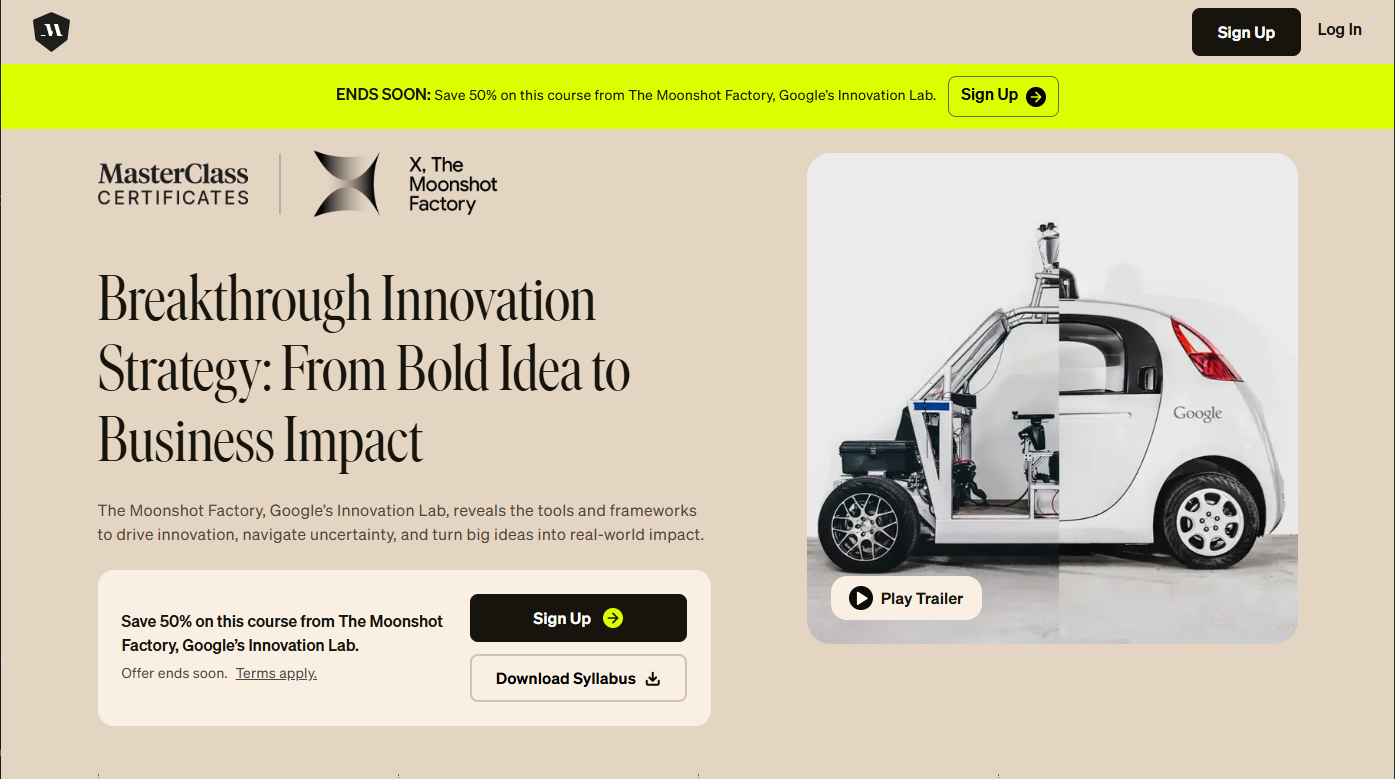
Masterclass certificate – Breakthrough Innovation Strategy
$499.00 Original price was: $499.00.$60.00Current price is: $60.00.
- 24/7 Contact Support & Telegram - Ecomkevin_1
- You Can Request Any Courses
- Original Courses HD Qualite and links updated
Guaranteed Safe Checkout


Description
Breakthrough Innovation Strategy: From Bold Idea to Business Impact
In today’s fast-changing business environment, innovation is no longer optional—it is the core driver of survival, growth, and long-term relevance. Companies that consistently outperform their competitors are not always the biggest or the oldest; they are the ones that know how to convert daring ideas into real, measurable outcomes. This is where a breakthrough approach to innovation becomes essential.
A well-designed innovation strategy bridges the gap between creativity and execution. It ensures that visionary thinking does not remain confined to brainstorming sessions but instead evolves into scalable solutions that generate value for customers and stakeholders alike.
This article explores how organizations can move from bold ideas to tangible business impact through a structured, disciplined, and outcome-driven innovation mindset.
Understanding Breakthrough Innovation
Breakthrough innovation is fundamentally different from incremental improvement. While incremental innovation focuses on refining existing products, services, or processes, breakthrough innovation challenges assumptions and redefines what is possible.
It often introduces:
-
Entirely new business models
-
Disruptive technologies
-
Novel customer experiences
-
Market-shaping solutions
These innovations do not simply compete within existing rules; they rewrite them. Companies that embrace this mindset position themselves as market leaders rather than followers.
Why Traditional Innovation Efforts Often Fail
Many organizations claim to prioritize innovation, yet struggle to see meaningful results. The problem is rarely a lack of ideas—it is a lack of structure, alignment, and execution.
Common reasons for failure include:
-
Innovation isolated from core business goals
-
Fear of risk and failure
-
Lack of leadership commitment
-
Poor resource allocation
-
Weak measurement of outcomes
Without a clear roadmap, even the most promising ideas lose momentum before reaching the market.
The Role of Strategic Clarity
Successful innovation begins with clarity. Organizations must define why they are innovating before deciding how to innovate.
Key questions to address include:
-
What problem are we trying to solve?
-
Who will benefit from this solution?
-
How does this align with long-term business objectives?
-
What kind of impact do we expect—revenue, efficiency, market share, or brand value?
Strategic clarity ensures that innovation efforts remain focused and relevant rather than scattered and experimental.
From Idea Generation to Opportunity Identification
Bold ideas alone do not create impact. They must be filtered, refined, and validated.
High-performing organizations follow a disciplined approach:
-
Insight discovery – Understanding unmet customer needs and market gaps
-
Idea generation – Encouraging diverse thinking across teams
-
Opportunity assessment – Evaluating feasibility, desirability, and viability
-
Prioritization – Selecting ideas with the highest strategic potential
This process transforms creativity into actionable opportunities rather than isolated concepts.
Building an Innovation-Driven Culture
Culture plays a decisive role in determining whether innovation thrives or fails. Organizations that foster experimentation, curiosity, and learning outperform those that punish failure.
An innovation-driven culture encourages:
-
Cross-functional collaboration
-
Psychological safety for new ideas
-
Rapid experimentation and feedback
-
Continuous learning and adaptation
Leadership must actively support this culture by rewarding initiative, not just results.
Designing a Scalable Execution Framework
Execution is where innovation strategies either succeed or collapse. Breakthrough ideas must be supported by systems that allow them to scale efficiently.
Key components of an effective execution framework include:
-
Agile project management methods
-
Clear ownership and accountability
-
Fast prototyping and testing cycles
-
Access to necessary resources and talent
Scalability ensures that successful pilots can grow into enterprise-level solutions without losing momentum.
Managing Risk Without Killing Creativity
Risk is inherent in innovation, but unmanaged risk can derail even the strongest initiatives. The goal is not to eliminate risk but to manage it intelligently.
Effective risk management involves:
-
Running small, controlled experiments
-
Using data to guide decision-making
-
Setting clear boundaries and success metrics
-
Learning quickly from failures
This balanced approach protects the organization while still allowing bold thinking to flourish.
Measuring Innovation Impact
What gets measured gets managed. Without clear metrics, innovation remains abstract and difficult to justify.
Meaningful innovation metrics may include:
-
Time-to-market
-
Customer adoption rates
-
Revenue contribution
-
Cost reduction
-
Operational efficiency gains
Tracking outcomes ensures that innovation delivers real business value rather than theoretical potential.
Aligning Innovation With Long-Term Growth
True innovation is not about short-term wins—it is about sustained competitive advantage. Organizations must align innovation initiatives with their broader growth strategy.
This alignment helps:
-
Strengthen brand positioning
-
Open new revenue streams
-
Future-proof the business against disruption
-
Enhance customer loyalty
When innovation supports long-term goals, it becomes a strategic asset rather than a side project.
Leadership’s Role in Driving Transformation
Leadership commitment is the single most critical factor in innovation success. Leaders must act as champions, not just sponsors.
Effective innovation leaders:
-
Set a clear vision
-
Remove organizational barriers
-
Allocate resources strategically
-
Encourage calculated risk-taking
Their involvement signals that innovation is a priority, not an experiment.
Turning Innovation Into a Competitive Advantage
Organizations that consistently translate bold ideas into impact create a self-reinforcing cycle of growth. They attract top talent, gain customer trust, and stay ahead of market shifts.
By combining strategic clarity, cultural alignment, disciplined execution, and outcome measurement, businesses can transform innovation from a buzzword into a powerful engine of success.
Conclusion
Innovation is not about isolated creativity—it is about transformation. A structured approach ensures that visionary ideas evolve into solutions that matter. When organizations commit to this journey, they move beyond experimentation and unlock sustainable value.
Reviews
There are no reviews yet.