
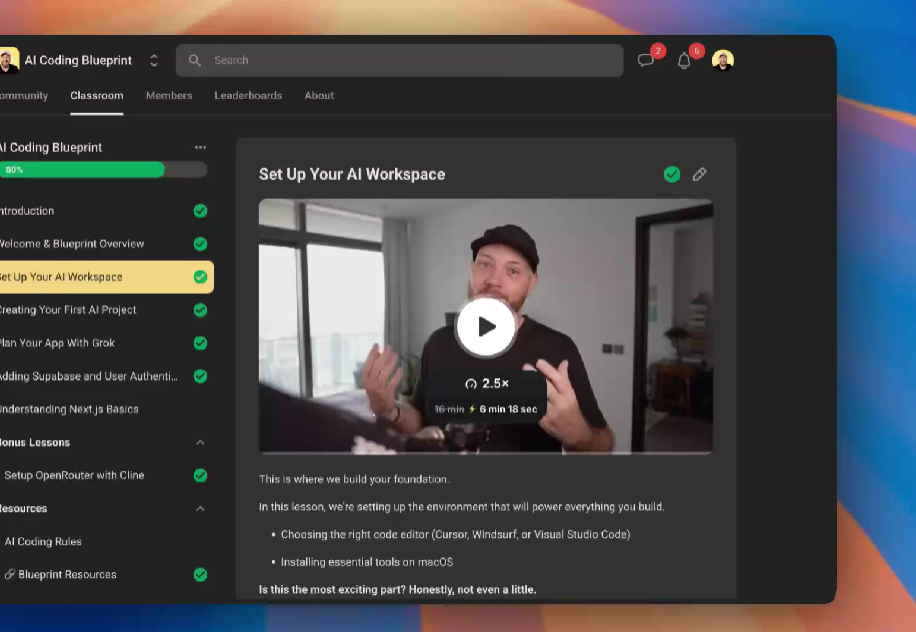
Robin Ebers – AI Coding Blueprint
$497.00 Original price was: $497.00.$29.00Current price is: $29.00.
- 24/7 Contact Support & Telegram - Ecomkevin_1
- You Can Request Any Courses
- Original Courses HD Qualite and links updated
Guaranteed Safe Checkout


Description
Introduction: The New Era of AI-Driven Coding
The world of software development is moving faster than ever. Artificial intelligence is no longer a futuristic idea — it has become a daily tool for programmers, startups, educators, and digital creators. Among the newest and most impactful systems shaping this transformation is Robin Ebers – AI Coding Blueprint, a structured approach designed to simplify coding, automate complex tasks, and improve project outcomes. This blueprint is not just a collection of tools; it is an entire framework that guides learners and professionals toward mastering code creation with clarity, speed, and efficiency.
In this article, you’ll explore every dimension of modern AI-assisted development — from workflows and automation to use cases, benefits, challenges, and career impact. Everything is written in natural language so you can use it for ranking, readability, and user engagement.
1. Understanding the Core Idea Behind AI-Driven Coding Systems
Why AI in Coding Is Becoming Essential
Coding was once a rigid discipline requiring years of practice and deep knowledge of multiple languages. While expertise still matters, AI has reshaped the landscape by offering real-time assistance, automated debugging, and guided development paths. This shift allows beginners to learn faster and experts to scale their projects more efficiently.
How AI Coding Frameworks Work
AI systems analyze patterns from millions of code samples, understand context, and provide step-by-step suggestions. The workflow typically includes:
-
Input prompts or requirements
-
AI-based code generation
-
Automated corrections and debugging
-
Structural improvements
-
Deployment suggestions
-
Optimization insights
This creates an environment where development feels intuitive, even for those starting with limited experience.
2. The Philosophy Behind Modern AI Coding Blueprints
Structured Learning Over Random Tutorials
The biggest issue most learners face is inconsistency. Watching random tutorials or copying code from the internet leads to confusion. A blueprint-style system offers structured pathways that guide you through concepts in the right order.
Breaking Down Complexity
AI-driven systems divide projects into smaller components, turning overwhelming problems into manageable tasks. Instead of building an entire app at once, you work on:
-
Database structure
-
API endpoints
-
UI components
-
Logic layers
-
Security
-
Testing
AI monitors the flow and fills in the necessary details.
3. Key Components of an AI-Assisted Coding System
1. Prompt Engineering Module
Prompt engineering is the skill of giving clear instructions to AI. The better the prompt, the more accurate and functional the code. A good blueprint teaches how to structure these prompts:
-
Describe the goal
-
Clarify the language or framework
-
Provide an example
-
Specify outputs
-
Mention constraints
2. Automation Tools
These tools accelerate workflows through features like:
-
Automatic code generation
-
Bug detection
-
Code refactoring
-
Unit test creation
-
Security checks
-
Performance optimization
3. Project Templates
Ready-made templates for apps such as:
-
E-commerce
-
LMS platforms
-
Chat systems
-
Booking apps
-
Dashboard systems
-
Portfolio sites
Templates save weeks of development time and ensure clean architecture.
4. Real-World Case Studies
A strong blueprint includes real examples of applications built using AI systems. case studies allow learners to understand:
-
Project goals
-
Tools used
-
Code structure
-
Challenges faced
-
Solutions implemented
4. How AI Changes the Learning Process for Beginners
Guided Learning Means No More Confusion
Beginners often feel overwhelmed with coding rules, syntax, and errors. AI simplifies this by acting as a personal tutor that:
-
Explains concepts
-
Suggests fixes
-
Highlights mistakes
-
Provides examples
Faster Progress with Less Frustration
Beginners can build apps in weeks instead of months. The frustration of debugging for hours is replaced with instant guidance that shows what went wrong and how to fix it.
5. How AI Helps Intermediate Developers
Leveling Up Through Optimization
Intermediate developers often understand the basics but struggle with:
-
Clean architecture
-
Efficient logic
-
Scaling
-
Reusability
-
Deployment
AI helps refine these elements so they can write professional-level code.
Mastering Multiple Languages Easily
Developers no longer need to fear switching between Python, JavaScript, Go, or Java. AI explains syntax differences and generates cross-language conversions instantly.
6. How AI Empowers Professional Developers
Boosting Productivity
Professional developers save hours every week using AI:
-
Faster coding
-
Quick debugging
-
Automated documentation
-
Performance tuning
-
Rapid prototyping
Improved Quality Assurance
AI tools create unit tests, find security flaws, suggest optimizations, and prevent major bugs before deployment.
7. Real-World Use Cases of AI-Driven Coding Systems
1. Startups
Startups use AI coding frameworks to build MVPs quickly while reducing development costs. This enables faster launches and easier investor pitches.
2. Agencies & Freelancers
Client deadlines become easier to manage because AI handles repetitive coding tasks, documentation, and testing.
3. Educators & Students
AI frameworks are used in coding bootcamps, universities, and online learning platforms to provide instant feedback to students.
4. Entrepreneurs With No Coding Knowledge
Non-technical founders can now build functional prototypes, automate workflows, and understand app logic without hiring big teams.
8. The Power of AI-Driven Workflows
1. Requirement Breakdown
AI can interpret vague ideas and convert them into clear software requirements.
2. Architecture Design
It creates database schemas, backend flow, frontend structure, and API maps.
3. Code Generation
The AI writes clean, modular code in the language of your choice.
4. Debugging & Optimization
Errors are caught early, and performance improvements are suggested automatically.
5. Testing Automation
AI produces:
-
Unit tests
-
Integration tests
-
Load tests
6. Deployment Assistance
It guides you through Vercel, AWS, Render, Firebase, or custom hosting.
9. Skills You Gain Through an AI Coding Blueprint
1. Code Architecture Mastery
You learn how good software is structured from start to finish.
2. Debugging Confidence
AI explains every bug in simple language so you understand the root cause.
3. App Development Speed
Projects that once took months now take days or weeks.
4. Prompt Engineering Expertise
This becomes a valuable skill in the AI era.
5. Problem-Solving Mindset
AI doesn’t just give answers — it teaches you how to think like a developer.
10. Challenges and Limitations
AI Is Not a Replacement for Logic
Developers must still understand:
-
Data flow
-
User requirements
-
Security basics
-
Performance considerations
Ambiguous Prompts Create Incorrect Code
Poorly structured prompts lead to:
-
Wrong logic
-
Missing functions
-
Bugs
-
Security gaps
Need for Continuous Learning
AI evolves quickly, so developers must adapt using new tools and workflows.
11. Why AI Coding Frameworks Are the Future
AI isn’t here to replace developers — it’s here to enhance them. Every major tech company is using AI to reduce development time, improve accuracy, and scale projects efficiently. In the coming years, AI-assisted coding will be a standard part of software development worldwide.
Developers who learn to combine creativity with AI tools will become the most in-demand professionals in the global tech economy.
Conclusion
AI-driven coding systems have transformed the development world by making learning easier, workflows faster, and software quality more reliable. Whether you’re a beginner or a professional, adopting an AI coding blueprint helps you build apps more efficiently and understand coding at a deeper level. As AI continues to evolve, those who use these systems will remain ahead of the curve, building smarter, faster, and more powerful digital products.
Reviews
There are no reviews yet.